Related News
- 00
0000-00
How to Specify Heavy-Duty Marine Engineering Equipment for Offshore Projects - 00
0000-00
How to Select Automated Terminal Systems for High-Throughput Cargo Terminals - 00
0000-00
How Automated Bulk Cargo Handling Reduces Dust, Spillage, and Port Downtime - 00
0000-00
Technical Evaluation of Port Assets: Assessing Reliability, Condition, and Residual Life - 00
0000-00
Port Emissions Reduction Services: Building a Shore Power and Equipment Retrofit Plan
Technical Evaluation of Port Assets: Assessing Reliability, Condition, and Residual Life
A technical evaluation of port assets should establish whether an asset can continue performing its assigned duty safely and predictably, what restrictions are justified, and which deterioration mechanisms will govern its remaining service period. The answer cannot be derived from age, visual appearance, or maintenance expenditure alone. A quay crane with a sound-looking steel structure may have accumulated damaging fatigue cycles at a small number of welded details. A dredge pump may show acceptable pressure while losing efficiency through internal wear. An automated yard system may have mechanically serviceable vehicles but an obsolescence exposure in its control architecture that limits availability.
The evaluation therefore needs a traceable link between the asset's design basis, actual loading history, present condition, failure behavior, and intended future operating envelope. Reliability, condition, and residual life are related, but they are not interchangeable. Reliability concerns the likelihood of performing a required function over a stated period. Condition describes the observed state of components and structures. Residual life is an engineering estimate of the period or usage remaining before a defined limit state, refurbishment threshold, or replacement decision.
Start with the duty actually imposed on the asset
Nameplate capacity is a weak starting point when it is detached from duty. A ship-to-shore crane designed for occasional rated lifts experiences a very different damage pattern from one handling frequent near-capacity moves, repeated twin-lift cycles, or heavy out-of-gauge cargo. The same distinction applies to stacker-reclaimers, mobile harbor cranes, conveyor transfer stations, automated guided vehicles, hopper systems, cutter suction dredgers, and trailing suction hopper dredgers.
Evaluation records should establish the operating regime before inspection findings are interpreted. Relevant evidence includes lifting spectra, duty cycles, travel distances, wind exposure, vessel or cargo mix, starts and stops, emergency events, alarms, utilization periods, and prolonged idle intervals. Idle equipment is not automatically preserved equipment: coastal corrosion, condensation within electrical cabinets, lubricant degradation, seal hardening, and battery deterioration continue while production is stopped.
Loading information must also distinguish between nominal load and dynamic load. Slewing, trolley acceleration, skewing, rail irregularity, impact at end stops, grab closing forces, and load sway can create local stresses not represented by a simple lifted-tonnage record. For dredging assets, slurry density, particle size, suction depth, pump speed, pressure fluctuations, and pipeline routing alter wear and mechanical loading. A low annual operating-hour figure may conceal severe abrasive duty.
Build the evidence base before assigning condition ratings
A defensible technical evaluation combines documents, inspection observations, functional evidence, and targeted testing. These sources should be reconciled rather than treated as independent proof. A maintenance record showing repeated gearbox oil changes, for example, does not confirm gearbox health. It may indicate disciplined preventive maintenance, but it may also indicate contamination, overheating, poor alignment, or an unresolved ingress route.
Useful source material includes original drawings, material specifications, fabrication and repair records, load-test history, inspection reports, fault logs, work orders, lubrication records, vibration trends, oil analyses, electrical schematics, software version histories, spare-parts data, and records of structural modification. Missing records are themselves an evaluation finding because they reduce confidence in calculations and narrow the conclusions that can be supported.
Inspection scope should follow probable failure modes. Broad visual inspection remains necessary, particularly around corrosion traps, drainage paths, cable entries, access platforms, machinery foundations, rail clamps, boom hinges, slew-ring supports, and areas altered by prior repairs. Yet visual inspection alone is poorly suited to finding early fatigue cracking, internal corrosion, hidden weld discontinuities, bearing race damage, insulation deterioration, or degradation within hydraulic components.
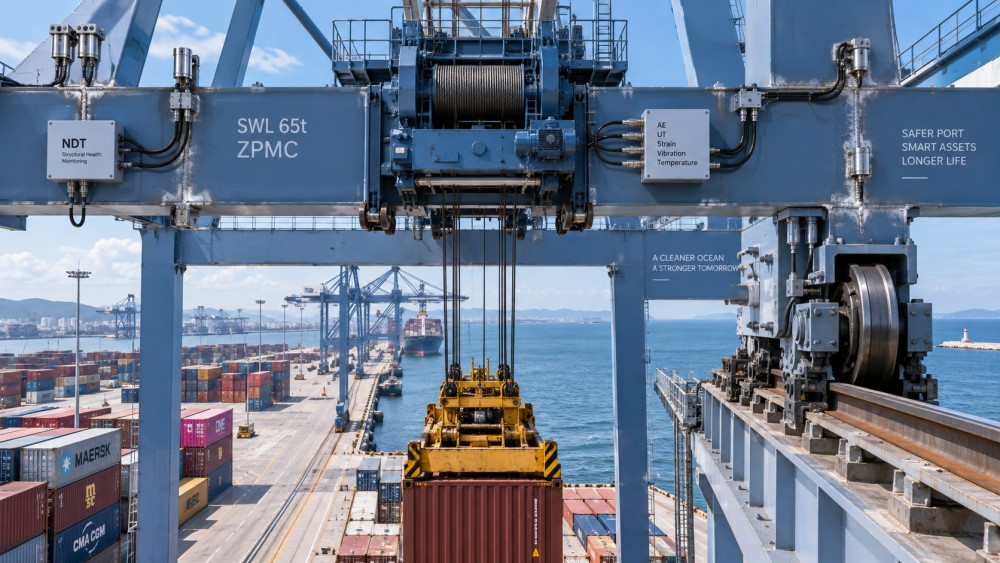
Non-destructive examination should be selected for the suspected mechanism and geometry. Magnetic particle testing is useful for surface-breaking cracks in ferromagnetic steel, especially at welded toes and highly stressed details. Dye penetrant testing can reveal surface discontinuities on suitable clean surfaces. Ultrasonic testing supports thickness measurement and internal flaw investigation, although access, coating condition, geometry, and operator technique influence interpretation. Phased-array ultrasonic methods can provide more detailed characterization in complex weld areas, but the result still requires correlation with the structural detail, stress direction, and repair history.
Structural condition: locate damage, then explain it
Corrosion loss should not be assessed as a site-wide average. Localized thinning at splash zones, deck interfaces, box-girder drainage pockets, ladder supports, bolted connections, or areas behind damaged coatings can be more significant than uniform loss across a large member. Thickness readings need a defined grid and reference to nominal plate thickness, corrosion allowance where applicable, and the component's load path. A small reduction in a lightly loaded cover plate does not have the same consequence as loss near a compression flange, pin connection, rail seat, or fatigue-sensitive attachment.
Cracks demand causal analysis. A crack at a weld toe may arise from cyclic stress concentration, inadequate weld profile, an attachment that restrains movement, corrosion-assisted fatigue, or a change in load path after modification. Grinding out and rewelding the visible crack without removing the driving condition can produce repeat damage adjacent to the repair. Where repeated cracking is found, the evaluation should examine weld geometry, residual distortion, connection stiffness, load spectrum, alignment, and prior repair quality.
Structural calculations become meaningful only when the model reflects the current asset. Added walkways, cable trays, strengthening plates, replacement machinery, revised lifting devices, altered boom geometry, and changed operating modes can affect mass distribution, stiffness, wind area, and fatigue demand. Assumptions inherited from original design documentation should be tested against field measurements and confirmed configuration.
Residual life is a damage estimate, not a calendar prediction
For fatigue-critical steelwork, residual life assessment generally compares accumulated and forecast stress cycles with the resistance of relevant details. The calculation requires realistic stress ranges, not merely maximum stress, because fatigue damage is driven by repeated variation. Cycle counting from monitoring data is valuable when it captures representative operation. Where direct monitoring is unavailable, duty records and equipment configuration can support a conservative reconstruction, provided uncertainty is clearly stated.
A residual-life result should be expressed alongside its assumptions: intended duty, load spectrum, inspection coverage, corrosion condition, detail category, repair status, and any restrictions imposed. A nominal remaining-life figure without these conditions can be misused as an unconditional operating approval. Where evidence is sparse or crack growth is active, inspection intervals and operating limits may be more appropriate outputs than a long-term projection.
Mechanical systems: separate wear from functional margin
Mechanical condition is often misjudged by looking for obvious noise, leakage, or vibration while the equipment is lightly loaded. Gearboxes, wheel assemblies, sheaves, brakes, couplings, bearings, hydraulic cylinders, and dredge pumps should be assessed under representative duty where it is safe to do so. The aim is to determine whether the system retains adequate functional margin, rather than merely whether it still moves.
Brake assessment should include torque capability, lining condition, disc or drum surface state, response time, hydraulic or electrical actuation integrity, and the behavior of holding and emergency functions. A brake that stops an unloaded trolley may still be inadequate under the required inertia, gradient, wind, or fault condition. Similarly, wheel-flange wear may result from normal service, but accelerated wear can indicate rail misalignment, unequal wheel loading, skew control issues, bogie distortion, or inadequate rail fastening.
Lubricant analysis adds value when sampling is consistent and the result is interpreted as a trend. Water ingress, particle contamination, viscosity change, oxidation, and metallic debris can point toward a developing problem, but a single sample rarely identifies the component condition with certainty. Sampling location, oil age, top-up practice, filtration, and recent maintenance affect the result. An unusually clean oil sample after a change should not be treated as proof that the replaced system is healthy.
Electrical, control, and automation exposures
For automated and remotely controlled equipment, availability depends on physical machinery and the integrity of the control chain. Technical evaluation should map sensors, field networks, programmable controllers, drives, safety circuits, location systems, wireless links, servers, and interfaces to terminal operating software. The purpose is not to judge software by appearance, but to identify single points of failure, unsupported components, undocumented logic changes, degraded communications, and recovery procedures that cannot be reliably executed.
Intermittent faults require attention because they are frequently masked by reset-and-return behavior. A drive trip caused by overload differs materially from one caused by loose control wiring, insulation breakdown, encoder signal loss, excessive regenerative voltage, network latency, or a parameter mismatch following replacement. Fault codes should be reviewed with timestamps, operating state, environmental conditions, and subsequent corrective action. Repeated alarms that are routinely acknowledged deserve investigation even when they have not yet produced a prolonged outage.
Electrical enclosure condition is also part of asset condition. Examine ingress protection in practice, not only the original rating: failed door seals, unsealed cable entries, blocked ventilation, condensation, salt deposits, damaged gland plates, and unsuitable cabinet cooling shorten component life. Thermal imaging can identify high-resistance joints, overloaded conductors, unbalanced phases, and abnormal heating, but readings must be taken under meaningful load and compared with similar components under similar conditions.
From findings to an operational decision
Condition grades are useful only when they lead to defined action. The evaluation should distinguish defects requiring immediate restriction from defects that can be managed through monitoring, planned repair, refurbishment, or replacement. Criticality depends on consequence and detectability as well as defect severity. A modest defect in a redundant conveyor drive has a different operational consequence from a similar defect in a unique crane hoist brake or a dredge pump needed to maintain navigable depth.
Recommended actions should state the component, observed evidence, failure mechanism, consequence, required intervention, verification method, and any temporary operating limitation. Vague recommendations such as “monitor condition” create avoidable ambiguity. A useful monitoring instruction defines what parameter will be monitored, where the baseline comes from, what change triggers reassessment, and whether monitoring is intended to detect deterioration, confirm a repair, or manage uncertainty pending further examination.
Residual-life conclusions should remain aligned with the planned operating envelope. Extending service under the same duty is one decision; increasing lift frequency, adopting heavier spreads, operating in more severe wind exposure, adding automation hardware, or moving a crane to a different rail foundation is another. Reassessment is warranted whenever the duty, structural configuration, environmental exposure, control architecture, or maintenance strategy changes materially. The value of a technical evaluation lies in preserving that connection between evidence and the conditions under which its conclusion remains valid.
Related News

How to Specify Heavy-Duty Marine Engineering Equipment for Offshore Projects
Heavy duty marine engineering equipment: learn how to specify reliable offshore assets for safety, uptime, integration, lifecycle cost, and project success.

How to Evaluate a Container Handling Equipment Exporter for Port and Yard Projects
Choose the right container handling equipment exporter with a practical guide to compliance, automation, service support, delivery reliability, and lifecycle value.

How to Select Automated Terminal Systems for High-Throughput Cargo Terminals
Automated terminal systems for cargo terminals: learn how to select scalable, resilient solutions that boost throughput, streamline integration, and control lifecycle risk.

How Automated Bulk Cargo Handling Reduces Dust, Spillage, and Port Downtime
Automated cargo handling for bulk cargo cuts dust, spillage, and port downtime through stable flow control, smart sensing, and coordinated recovery.

What Should a Port Capacity Plan Measure Before a New Berth or Crane Investment?
Port capacity planning: discover the metrics that reveal whether a new berth or quay crane will improve throughput, service reliability, and investment returns.
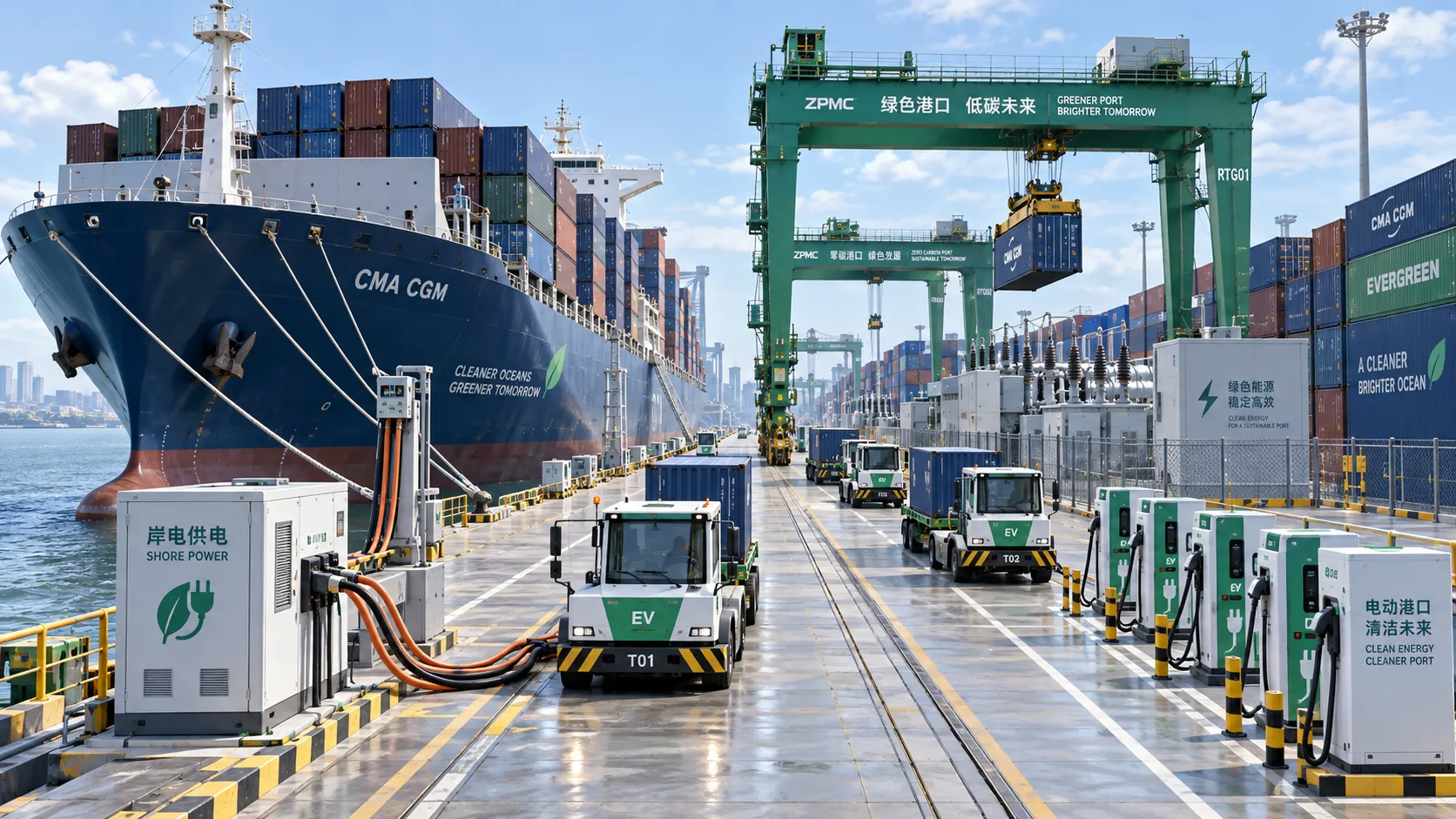
Port Emissions Reduction Services: Building a Shore Power and Equipment Retrofit Plan
Port emissions reduction services help terminals build practical shore power and equipment retrofit plans that cut emissions, protect throughput, and scale with confidence.

Selecting Port Control Systems for Vessel Traffic: Coverage and Fail-Safe Design
Port control systems for vessel traffic: learn how to assess coverage, redundancy, fail-safe recovery, cybersecurity, and operator workflows for safer port operations.

Selecting Automated Cargo Handling Systems for Terminal Throughput and Yard Limits
Automated cargo handling systems for maritime terminals: learn how to balance berth throughput, yard limits, automation software, and lifecycle costs for smarter terminal decisions.

Smart Port Solutions for Berth Planning: Reducing Vessel Wait Times and Conflicts
Smart port solutions for berth planning reduce vessel wait times, prevent conflicts, and optimize quay, crane, and yard resources for faster turnarounds.